The SENECA project progresses in the development of monitoring systems for wind energy structures
The SENECA project, under development by Nabrawind and AIMEN, has entered its final stage and is expected to be completed by the end of the next year. Nabrawind and Aimen have undertaken this project with the aim of developing and integrating advanced sensing systems for the monitoring of manufacturing processes and the structural health of wind energy components, as well as real time lifetime prediction models to optimise operation and maintenance strategies.
The project is led by Nabrawind, which is responsible for industrial leadership, requirements definition and validation of the developed solutions, with AIMEN acting as technical coordinator, in charge of research activities, the development of embedded sensors, signal processing and structural health monitoring models, as well as overall technical coordination of the consortium.
The general objective of SENECA is the development of intelligent wind energy materials and structures based on composite materials, enabling the optimisation of manufacturing processes, continuous structural health monitoring and the generation of knowledge on the relationship between manufacturing events and long-term structural behaviour in service. To this end, the project focuses on the development of minimally invasive, embedded unifilar sensors (SUF) capable of providing reliable data throughout the thickness and surface of critical regions of the component.
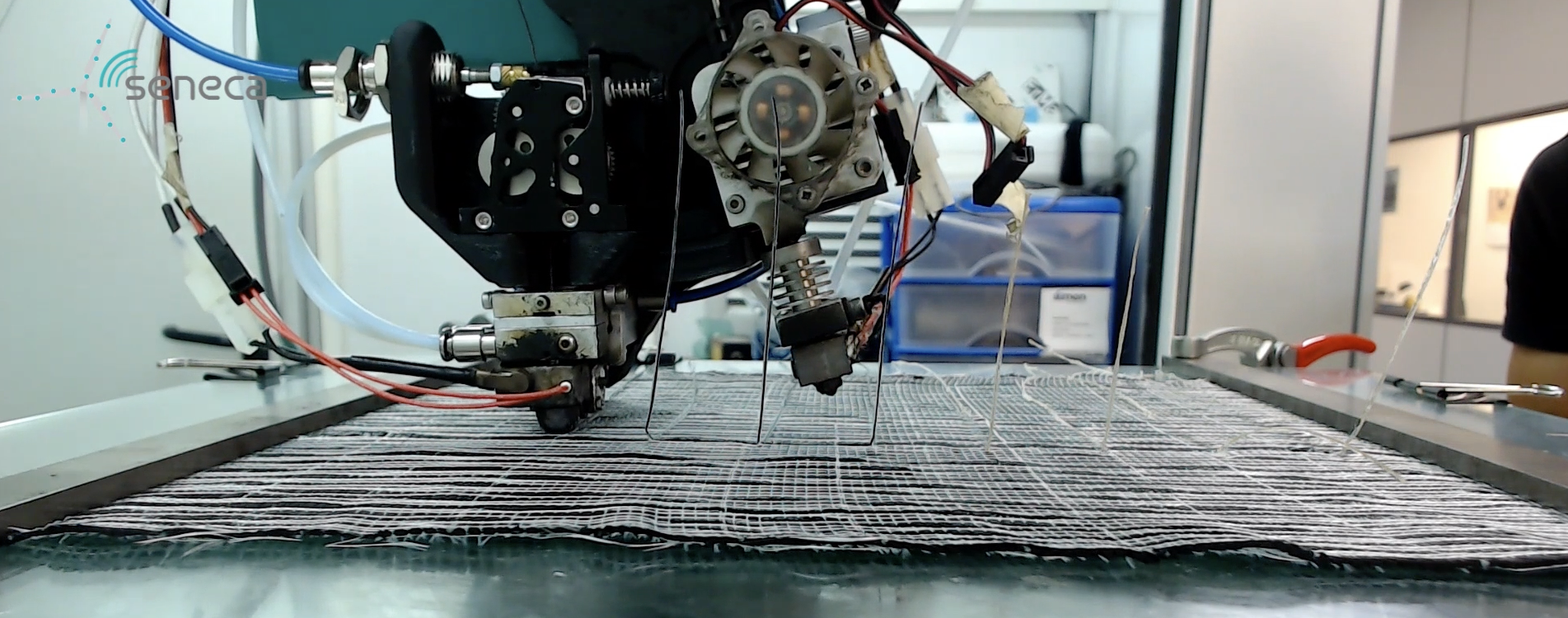
Several technological solutions have been developed and optimised, including the development of SUF fibre-optic sensors and carbon nanotube-based sensors, their integration into dry fibre preforms, the development of automated sensor deposition technologies, as well as signal interpretation methodologies and strategies for optimal sensor placement during resin infusion manufacturing processes.
SENECA is currently in its final stage, focused on the embedding of the sensors during the manufacturing of a representative wind energy component, with the aim of monitoring both the manufacturing process and fatigue testing. These activities will allow the validation of the SENECA solution on an industrial test bench, reaching a Technology Readiness Level (TRL) 6.
The project has a planned duration of 36 months (December 2023 – November 2026) and a total budget of €515,840.15, funded through the 2022 Public–Private Partnership programme.