

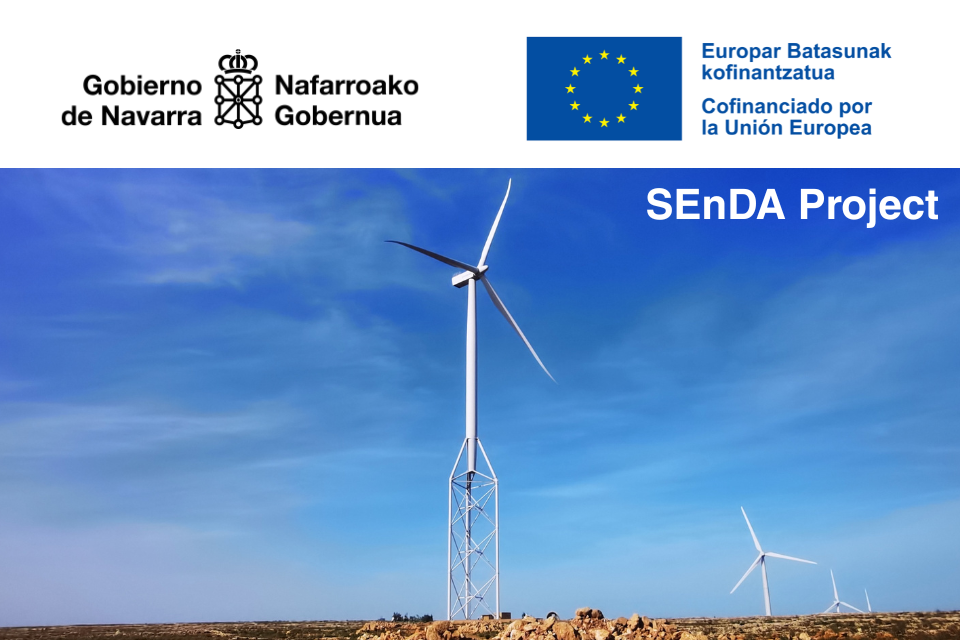
The SEnDA project drives new control technologies for extra-high onshore wind turbines
The consortium formed by the technology centre CENER (National Renewable Energy Centre of Spain) and the companies Nordex Group, Nabrawind, and MELETEA has announced that their joint research project, SEnDA, is advancing towards the final phase of technology validation aimed at extending the operational life of onshore wind farms.
The project has developed and validated intelligent solutions for control, monitoring, and high altitude servicing, designed for the next generation of high capacity onshore wind turbines, which will reach hub heights of up to 200 metres. These technologies aim to reduce the Levelised Cost of Energy (LCOE) and facilitate the deployment of large turbines in onshore wind farms.
The project consortium brings together complementary industrial and technological capabilities, strengthening R&D&I efforts and supporting the market transfer of new tools for design, diagnostics, and operation in the wind energy sector. Its composition, CENER, Nordex Group, Nabrawind, and the SME MELETEA (specialised in FEM calculations), ensures a multidisciplinary approach aligned with the needs of the wind sector.
Among its main results, SEnDA has developed:
- New monitoring and control strategies for extra-high turbines.
- Vibration mitigation measures and tools to improve safety and load management during installation.
- Advanced structural health-monitoring solutions for critical wind energy system components.
Thanks to these advancements, the SEnDA project will help strengthen the wind energy value chain operating in Navarra. It is expected to generate applied knowledge in innovation and new products, thereby supporting the consolidation of qualified employment across companies and technology centres in the region, in line with the Navarra Green ecological transition strategy promoted by the Government of Navarra.
Nabrawind’s role in the project
For Nabrawind, SEnDA has represented a new challenge fully aligned with its innovation strategy. The company has played a central role in the following achievements:
- Structural modelling and validation of the new wind turbine, as well as the definition of tower specifications.
- Development of analytical and numerical models for the controller’s Digital Twin.
- Calculation and analysis of VIV vibrations during installation and operation phases.
- Field validation of the new solutions.
- Development of high-altitude service systems and sensorisation strategies for the remote monitoring of turbine structural health.
The project is co-funded by the Government of Navarra and the European Union through the FEDER 2021–2027 Programme.